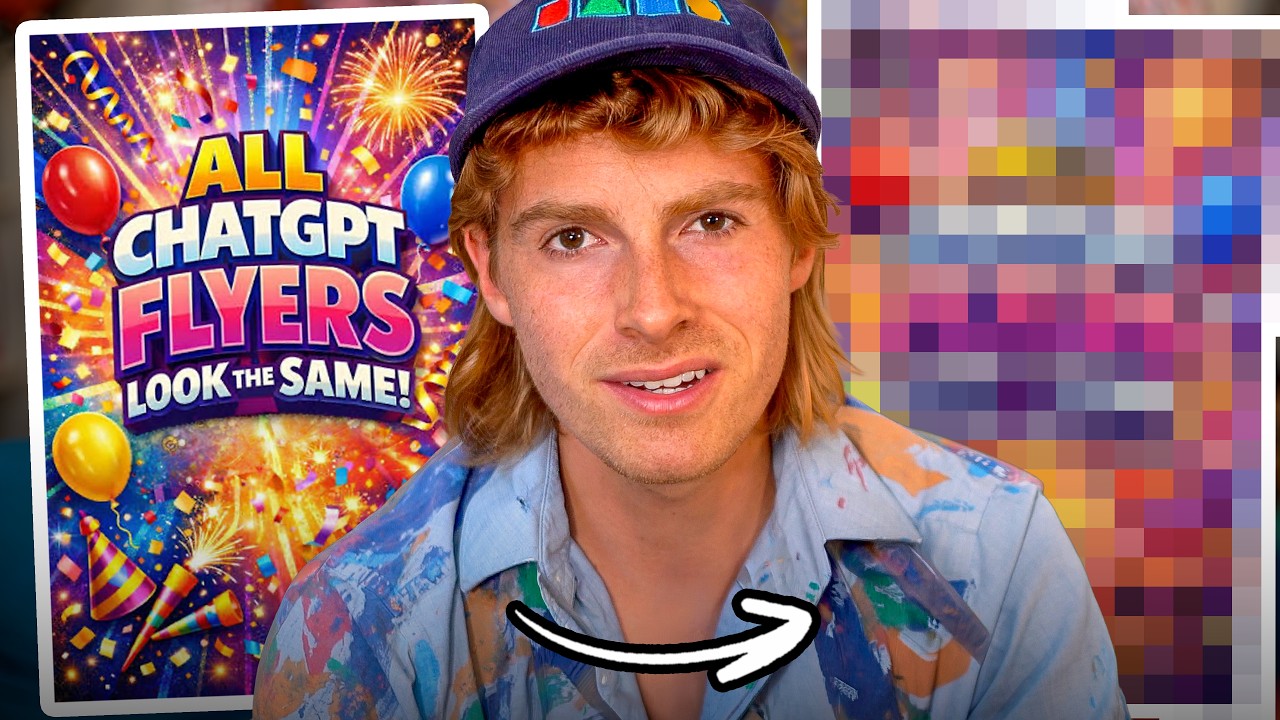
You might have noticed flyers for small businesses starting to look the same in recent months, not because everyone's jumping on one of the big graphic design trends of 2026, but because of a technology. AI-generated flyers are everywhere, and they're replacing the great tradition of folk design built in Photoshop or Microsoft Paint.
Suddenly everything from your local church's car boot sale to the food truck on the pavement outside it is presenting itself with AI-generated visuals. And despite the theoretically infinite creative possibilities that AI image generators afford, most of them look mediocre, if not outright traumatic when it comes to AI menus and food imagery.
On social media, graphic designers are trying to make the world see sense.
The vast array of AI flyers cropping up all over social media and even printed in physical form suggests that many small businesses see such assets in purely informational terms: an inconvenience needed to communicate a product or service rather than a vital piece of branding that can say a lot about a business and the people behind it.
The fightback is in full swing on Instagram and YouTube, with a recent flurry of posts and videos that seek to highlight that ethical issues and simply the cheap generic look of AI-generated visuals could put customers off.
Designers and illustrators are also taking AI-generated flyers from the internet and trying to show how they would have approached the brief, leading to much more unique, eye-catching and coherent results.
I Redesigned the WORST AI Flyers I could find - YouTube
Some designers are using the process like a real brief to practice their skills and others to promote their services.
Others are so tired of seeing bad AI designs that they're imploring businesses to design their own assets in any other way.
Some people appear to have got the message. At least, there's a simultaneous trend running of small businesses declaring on Instagram that they'll be communicating using pen and paper instead of AI flyers. Others have been sharing simple tips for other businesses on how to make a flyer without using AI.
The AI proponents will say bad users are the cause of generic-looking flyers, not AI itself. All you need to do is prompt better. But even with the most detailed 1,000-word prompt followed by multiple rounds of generations, there's an inherent tendency for AI image generation to gravitate to a statistical average of its data set and the verdicts of data annotators.
Before AI, we had bad Photoshop fails and the classic 'graphic design is my passion meme'. But at least amateur design had some personality. With AI, everything just looks a bit mid. For some businesses, that might be enough, but I think the trend towards rawer hand-crafted work may be building.
Instagram is a great place for your brand to be. Why? Because you can easily develop your brand and spread your reach. It can be scary not knowing how to make your page great and attract more followers. But the truth is, using Instagram in an effective way is pretty easy. Check out these ten Instagram growth strategies to up your Instagram game.
1. OPTIMIZE YOUR PROFILE.
Optimizing your profile involves morethan just having a fun profile picture. Your profile is the place people go to to get a feel for your brand, so it needs to strongly represent you! First things first, your profile picture should have your logo in it and your account name should be your brand. Next, make sure that your description includes a link to your website. If people are interested, they will want to see your website so make it easy for them. Lastly, put your slogan in your bio or write some fun sentences about your company that will draw people in. Remember, Instagram isn’t Linkedin, it’s more of a laid back, social app.
2. POST CONSISTENTLY
Let’s say people go to your profile and like what they see so they follow you, and you don’t post for the next two weeks. By the time you post again they will have lost interest. Let’s say instead you post four times in the two weeks prior to when they follow you and then don’t post for a month. Once again you will lose their interest and lose them as a follower. So, post consistently. Try to post two or three times a week. There is such a thing as overdoing it. If you post too often, people will get annoyed because they only see you in their feed and will stop liking your posts and eventually unfollow you.Find a balance and stick to it.
3. MAKE WEEKLY POST CATEGORIES
Every Wednesday at Colibri we post a Wednesday #WomanPower post on Instagram about a woman who inspires us. Posts like these keep followers looking forward to next week’s post and therefore they stick around. Here are some ideas to inspire a weekly post for you: If you are an influencer who focuses on clothing, you could do #ThriftyThursday where you post your favorite thrift store and thrift finds or upcycling tips on Thursday. Are you an interior design brand? On Fridays post your favorite #CoffeeTableRead.
4. ENGAGE WITH YOUR AUDIENCE
Engagement from your followers is super important. It helps build a following and means you have loyal customers. But how do you get engagement? Start engaging! Ask your followers to comment about something in the comments of a post, or to tag someone who inspires them on a Wednesday #WomanPower post. Shout out your followers in posts, respond to their DMs and comments or repost or comment on their posts about your brand. That way, your followers will want to engage with you because they know you will respond.
5. POST PERSONAL AND CLEAR IMAGES
If you always post stock photos, you won’t get likes. Your followers won’t trust you and will eventually unfollow you. People want to see into your brand so you need to post personal and real photos. Try to post clear and aesthetically pleasing images as well. Keeping to a certain color scheme and style that matches your brand is a good way to make your feed appealing while staying on brand.
6. MAKE FUN STORIES AND USE THEM CONSISTENTLY
Stories help keep your followers engaged and are a fun way to connect. Try making stories where you do polls or show the behind the scenes at work. Stories are not only fun to look at, but they are also fun to make. Get creative with it! Don’t be afraid to use filters and stickers. Use your stories to promote new posts or new blogs on your website.
7. DON’T BE AFRAID OF INSTAGRAM TV
Instagram TV can seem scary because it is live. Here are a few tips to make it easier:
The first few times you use Instagram TV, record your video first. The videos don’t actually have to be live!
Do an interview and ask your followers for questions. This way you can engage with your followers and won’t run out of questions.
If you own a warehouse or studio, show a behind the scenes of your space. You can also engage with you followers by asking them to guess what certain machines are, see if anyone has used them, etc.
8. MAKE YOUR CAPTIONS INTERESTING
Writing captions is the hardest part of Instagram for me. After writing and deleting tons of captions, I usually go with what I first wrote, so my advice is to trust your gut and don’t be afraid to make some jokes! If people are intrigued by your photo they will read your caption. You want your caption to satisfy their interest and encourage them to comment so make sure your captions are compelling.
9. TAKEOVERS
Takeovers are when brands partner with influencers or other brands and post in each other stories for a day. This is a great way to give your followers fresh new content while also being introduced to new potential followers. In your takeovers you can show behind the scenes from your office, what a day in your life looks like, etc. Have fun and get creative with takeovers.
10. USE HASHTAGS
Although hashtags may seem old school, they do so much for your brand on Instagram, so use them! They help people find you and introduce you to new followers. Make sure you use a consistent set of hashtags to describe your brand as well as more detailed ones to match the theme of your post. This way people will find you through a variety of searches. You are allowed to use up to 30 hashtags but using between 5–11 is best. A lot of people put their hashtags a few lines below their caption so that it’s easier to understand. To do this they put a period in every line to create space and then put their hashtags.
TAKEAWAY
Instagram is an app that you can really get creative and have fun with, so don’t be afraid of it. If you follow these Instagram growth strategies and adapt them to your brand, your Instagram presence and following will improve. The most important part is that you keep up all these new practices. Make a plan that is sustainable for your brand and stick with it. Now go and have some fun growing your Instagram
Fearing to be left behind in the social media race, the vast majority of brands have ventured into social media space with little strategic thought or understanding of how to get the most out of their platforms. Many brands are using their pages as avenues to run short-term behaviour and reward activities which may harm brand value in the long term by teaching already loyal consumers to become sensitive to sales promotions (Kotler & Lee, 2008; Schultz & Block, 2012; Gambetti & Graffigna, 2010; Nelson-Field et al., 2012; Romaniuk, 2011).
After a decade in business, Instagram boasts one billion active worldwide accounts (Instagram, 2020). As of April 2020, the US has the highest number of Instagram accounts of any country with 120 million users (Clement, 2020). Brands big and small across the globe are using Instagram to drive their marketing and sales efforts. “When 90% of accounts follow at least one business on Instagram, it goes without saying that brands want in on the marketing action, too,” (Chen, 2020).
Arguably, Instagram is the most important platform to succeed on in the Western World in 2020.
According to research by Neilsen (2015) Instagram campaigns have achieved results two to three times above those possible on other online channels for the same set of brands and advertising goals.
Why is this possible?
Instagram is so different from other social media options because it allows firms to tell compelling brand stories in the style of a visual diary, carefully selected to represent a chosen identity. A visual ‘lifestyle’ mood board loaded with brand associations.
Therefore, brands can truly integrate with other Instagram users, marketing themselves in a non-confrontational manner and portraying authenticity by downplaying commercial motives.
“People today are discontented with this commercial existence and lack faith in marketing, with almost everything in their lives seeming to be contrived,” (Napoli, Dickinson, Beverland, & Farrelly, 2014). To combat this, consumers no longer search for an objective truth of reality, but instead hunt for cues of authenticity (Beverland & Farrelly, 2010; Beverland, Lindgreen, & Vink, 2008; Peñaloza, 2000).
Brands that come across as inauthentic, seem intrusive and irritating to consumers (Hall, 2014). Conversely, consumers have reported being more receptive to brand messages if they are ‘hidden’ in social media, rather than presented as traditional direct advertising (Palmer & Koenig-Lewis, 2009).
How Brands Can Portray Authenticity on Instagram
1. Use ‘authentic’ cues
These specific firm-level intangible cues have been found to denote authenticity (Napoli et al., 2014, Gundlach & Neville, 2012; Sandlin & Pena, 2014; Harris & Deacon, 2011; Illicic & Webster, 2014):
A commitment to quality
Heritage
Relationship to place
Sincerity
Nostalgia
Craftsmanship
Consistency of design
Successful brands weave these cues into their Instagram advertising to build authenticity and credibility with their followers.
2. Personify the brand
Consumers use a firm’s Instagram account to build a picture of their favourite brand as if that brand was a human.
Instagram users I interviewed for my thesis about this phenomena could specifically describe the person they imagined a brand to be based on brand associations visually depicted in Instagram photos. For example:
“The skinny as, fashionable girl, who is kind of sulky, quite pale, slightly edgy, a bit too cool.”
“Dark moody type… She doesn’t care what other people think. Simple, clean-cut, no frilly stuff, and it’s not girly whatsoever… Just strong and independent, gives no shit.”
“This person’s [the brand as a person] concerned about their image. So, they dress nicely and have pretty nice branded clothes… Creative. Thinks a little bit differently.”
Portraying brands as ‘people’ on Instagram is tied to understanding how consumers come to see brands as authentic members of their Instagram communities. Social media space is personal and social and therefore corporate messages must be personable and relatable to be accepted by consumers (Chow & Shi, 2015; Simmons, 2007; Berry 2000).
I un-follow something as soon as it’s like ‘Shredzergram get the 60-day challenge for this much money’ because I’m like that’s no longer an inspiring pic with someone with nice abs, it’s now like, it’s a sale.
Human warmth and social presence are key factors in establishing relationships between brands and consumers (Chow & Shi, 215). Building and communicating a strongly humanized brand allows a firm to win consumer trust, generate a perception of credibility, and tell a compelling story (Berry, 2000).
Ruby and Superette [two brands] I stopped following. I think they posted too often and too advertisement-like. Whereas I like seeing people that look more natural, like it was almost someone’s page. When it looks too advertised it’s just boring… you want the brand to be more personable.
3. Telling a lifestyle story
Authentic brand perceptions are built via the creation of ‘brand lifestyle stories’. A lifestyle story was found to be crafted via a series of images depicting branded products in use in real-world situations.
I like that because… they’re not selling their product, but they’re selling like a lifestyle that comes with the product.
And:
It’s the lifestyle that they’re selling so it’s what I like to see.
Interviewees expected brands on Instagram to depict their products authentically in use, rather than hanging up in the shop. This allowed brands to downplay their commercial motives, and fit in more effectively with their consumers on Instagram.
The story going behind the photos can almost be just as important…as… if they’ve thrown up this new watch because they’ve got it into stock, or if it’s a sale on or something I’m just not that interested. Whereas if a guy had been out climbing the mountain with it and had been bashing through the snow for eight hours and then took a photo that was all covered in snow and it was like pouring down then that’s cool.
This style of marketing on Instagram means creating staged ‘brand autobiographical memories’ to tell a lifestyle story.
Sharing personal autobiographical memories is known to help people bond and make interactions more authentic and meaningful (Bluck, 2003). Visual autobiographical memories are snapshots that link a person to a memory or experience (Bluck, 2003). Authentic brands adapted to this method of digital self-identity presentation by staging ‘branded autobiographical memories’, which allow these brands to build authentic identities in the eyes of their consumers.
For example:
Huckberry does a lot of events… they were trying to get a whole lot of people together in Yosemite national park, in California and they were having photo-shoots. They were getting people out there as well, and so then it was like almost documenting that trip. And they had photos of guys in the hammocks that they sell, with sunsets behind them and the big cliff-faces in Yosemite, and that had all been going on while they were having this event so that when there is a story to tell I like it.
Maintaining continuity of elements over time allows a firm to align their brand with a specific lifestyle theme; (for example, wilderness exploring or surfing) that the consumer can relate to. Congruency between the lifestyle portrayed by the brand on Instagram and the consumer’s values drives genuine consumer connections. Consumers choose brand companions that re-affirm their ideas of themselves (Kumar, Luthra & Datta 2006).
Say, it was a surfing brand, I’m taking surfing pictures so I have a common interest which is surfing or the outdoors or something kind of like the drawcard. So the reason that I follow them [brands] is that they’re posting… they post material that’s similar to myself.
Aspirational lifestyle escapism also has a role here. It fills a hedonic need of consumers: to escape their own perceptively mundane realities, and imagine themselves as part of a new and exciting digital world. The use of artistic visuals allows consumers to achieve the hedonic escapism they desire by allowing firms to effectively downplay their commercial motives and present a virtual ‘brand-world’ that consumers can escape into. For example:
I think she’s in France which is just the ultimate chic to me. Walking through a European town, kind of old school, black and white, she looks chic. She’s not actually even wearing the Lonely Hearts clothing so it’s not really an advert, but I’d love to be in Paris, sitting at a café. She’s sitting by herself, I’m quite a wanderer by myself. I like wandering. It looks kind of like she is listening to people’s conversations. She’s really chic, and I’d look at that in an art book.
The reference above to Instagram images not being perceived as adverts, but more as pictures that could be found in an art book is at the crux of why Instagram is so effective for perceptively authentic brand building.
Artistic visual media on Instagram allows firms to downplay their commercial motives which encourages consumers to hedonically escape into a brand’s lifestyle story. As another example:
This picture here is a picture of someone, it looks like an old picture, wearing a Belstaff jacket that you can’t really see, and they’re riding a motorbike away from you so the jacket is not the focal point of the picture, it’s the motorcyclist… I like how it’s subtle. It’s not really trying to sell you anything. It’s displaying how the products can be used and that’s how I’d like to use the product so that’s why I like it. I would like one of the jackets and I would like a motorbike like that.
4. Using consumer-generated content
Featuring consumer-generated content allows brands to use their consumers as endorsers, which functions to further foster perceptions of authenticity due to endorser relatability (Kumar et al., 2006). This reflects the power of the typical person endorser which has long been acknowledged (McCracken, 1989), but also the power of directly bringing the consumer into the brand story (Gensler et al., 2013). For example:
I think it’s cool. It shows a connection between the brand and the consumer. It’s basically all trying to make it seem like it’s not a big corporate, and it shows how other consumers are using the products. Also the worn look… People like it. I’d quite like to see how a pair of shoes will look a couple of years down the line and what they can be used for.
And:
Lonely Girls Project is dedicated to all the Lonely girls that buy the Lonely Lingerie, and I think it comes through hashtags, so if you put a hashtag up under your post they can feature you under their page. And this is much more fun because you can see real people wearing it. Because you see the models wearing it and you think, really, does it sit that nicely? Then you see real people wearing it and you see people of different shapes and sizes who love their Lonely, and, you know, and it’s much more real… Rather than just a thing that seems unobtainable because you just see celebrities and models doing it.
A possible consumer-generated content feature on Instagram also provides some consumers with a reason to follow brands: the potential for wider exposure for their content, and fifteen minutes of fame. Multiple interviewees followed brands in the hope of having their photos featured.
Summary: How to get the most from Instagram for your brand
Market brands on Instagram as if the brand was a person, to allow consumers to befriend, connect with, and follow the firm as they would one of their best friends.
Use Instagram to tell lifestyle stories by constructing content based on staged autobiographical memories.
Maintain a continuity of elements over time to allow a firm to align their brand with a specific lifestyle theme.
Present content that is artistic and fits with the culture of Instagram as a community.
Recognise the value of using consumer-generated content to both make their brand relatable to consumers, and as a reason for consumers to tag the brand in the content they want featured, generating electronic word of mouth.
Virtual influencers are a growing trend now. Miquela and her creators are doing a fantastic job when it comes to developing storytelling and connecting to the audience. Marketers, influencers, and businesses have much to learn from her. From creating an excellent bio to selling a product, Miquela knows how to use her social media.
Robots can be tremendously successful in social media.
Lil Miquela is currently one of the most popular virtual influencers on Instagram.
She was created in 2016 by a company called Brud, in Los Angeles, and she is entirely computer-generated. But don’t let that fool you: Even though she’s a robot, Miquela has a strong personality.
She is 19 and has Brazilian and Spanish roots. Miquela is a singer who uses her social media to discuss travel, fashion, art, and lifestyle. The virtual influencer has 2.5 million followers on Instagram. Among the brand that she worked with are Prada, Off White, and Samsung.
And if you, like me, are amazed by the potential of the virtual influencers, there are some social media lessons that we can learn from the young Miquela.
Create a Good Bio
The bio is the first thing we see when we find a profile on Instagram. It is like the introduction of a text — it needs to make the user curious enough to scroll down and keep consuming your content. It’s the only opportunity to make an excellent first impression.
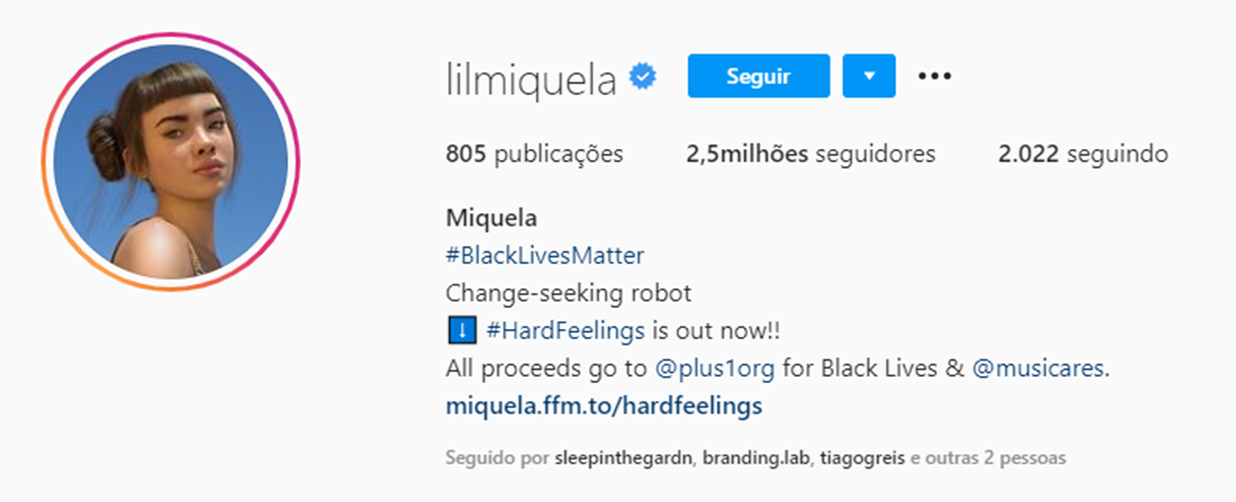
The picture below shows Miquela’s bio:
There are some elements Miquela uses to make a great bio:
Picture: Her profile picture contrasts with the pink circle of the stories. This contrast creates an interesting visual effect that attracts attention.
What to write on the bio: She uses the bio to reinforce her values through the #BlackLivesMatter movement and to communicate that she supports @plus1org and @musicares.
The power of links: Miquela announces that her single, “Hard Feelings,” is out. She has a compelling call-to-action, followed by a link at the end that directs followers to platforms in which they can listen to the music.
Personality: “Change-seeking robot” demonstrates her uniqueness. She is a robot, and this makes her authentic. Miquela uses it to build her storytelling. She’s not a regular robot: she’s a robot on social media. At the same time, she’s not a typical influencer either, because she’s not human.
Her Instagram account is one of the ways through which she promotes her songs. The promotion strategy is very robust and includes storytelling and most of Instagram’s other features.
Repetition
The most substantial aspect of Miquela’s promotion is repetition.
Considering that Instagram is a fast platform, repetition is crucial for an effective campaign. The same message gets across on multiple posts. Here’s how she promoted her latest song, “Hard Feelings”:
Different versions: “Hard Feelings” had three releases so far — the single, the music video, and the remix. She brings novelty to the same song, which keeps the audience interested.
Multiple posts: Since July 25, every single post on her feed references her song, “Hard Feelings.” That’s so far 22 pictures and videos, only on her feed.
Using multiple features
By promoting the song in different features, it’s simple to use the repetition strategy.
Link in bio.
She uses multiple videos and pictures on the feed.
Her strategy includes both stories and story highlights.
Storytelling
Whenever Miquela releases a new single, she develops a story behind it.
For the song “Speak Now,” she recorded an IGTV telling the story of how she recorded the music video with her ex. She says the experience helped her to overcome the breakup.
It becomes more than just music — it’s part of her personal story. This strategy works very well for other artists, such as Taylor Swift.
Story Highlights
Let’s analyze Miquela’s story highlights:
Here’s her strategy to produce excellent content for the highlights:
Visual identity: Every cover has the same visual identity. Each one is a picture with a black background, with colorful icons. This way, it’s easier to build appealing visual content and to maintain consistency.
Titles: The titles of the highlights are in caps lock, which makes it easier to read. Besides, they are short — each of them in only one word since there’s little space there.
Music:All highlights refer to Miquela’s music. She heavily uses this feature to promote her work.
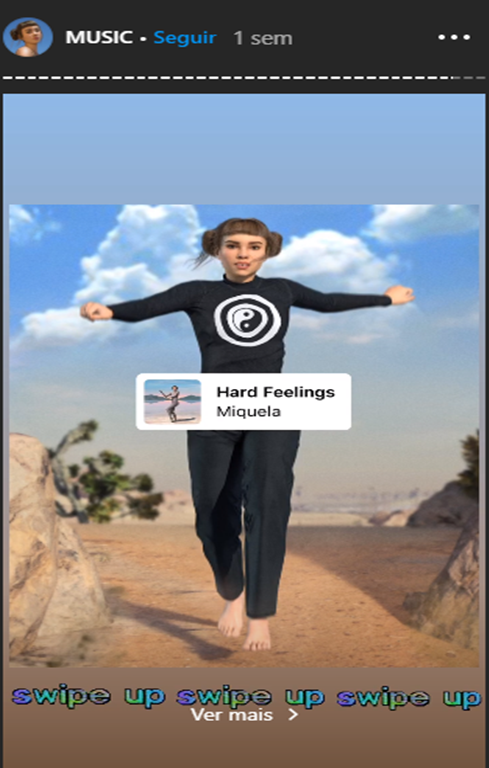
It’s easy to see that Miquela uses multiple features:
Swipe up: She uses the swipe function to promote her music.
Music: Miquela added her song to the“music” feature that’s available.
Icons:At the bottom, there’s the “swipe up” icon. This feature is a part of Miquela’s informal language, and this one is a clear call-to-action.
In other stories on the highlights, Miquela uses other features, such as reposting, short videos, pictures, and even texts for more serious topics. However, most of them are related to her music.
Adjust the Language to the Audience
This advice is as old as social media, but still overlooked by content producers: speak the audience’s language.
Unlike other platforms such as LinkedIn, Instagram offers fast and entertaining content. Miquela understands this and has developed a very informal style.
She expresses this informality in three ways: captions, comments, and videos.
Captions
Miquela writes captions to every single post. She uses them to promote her sings — as seen before — and to connect with the audience.
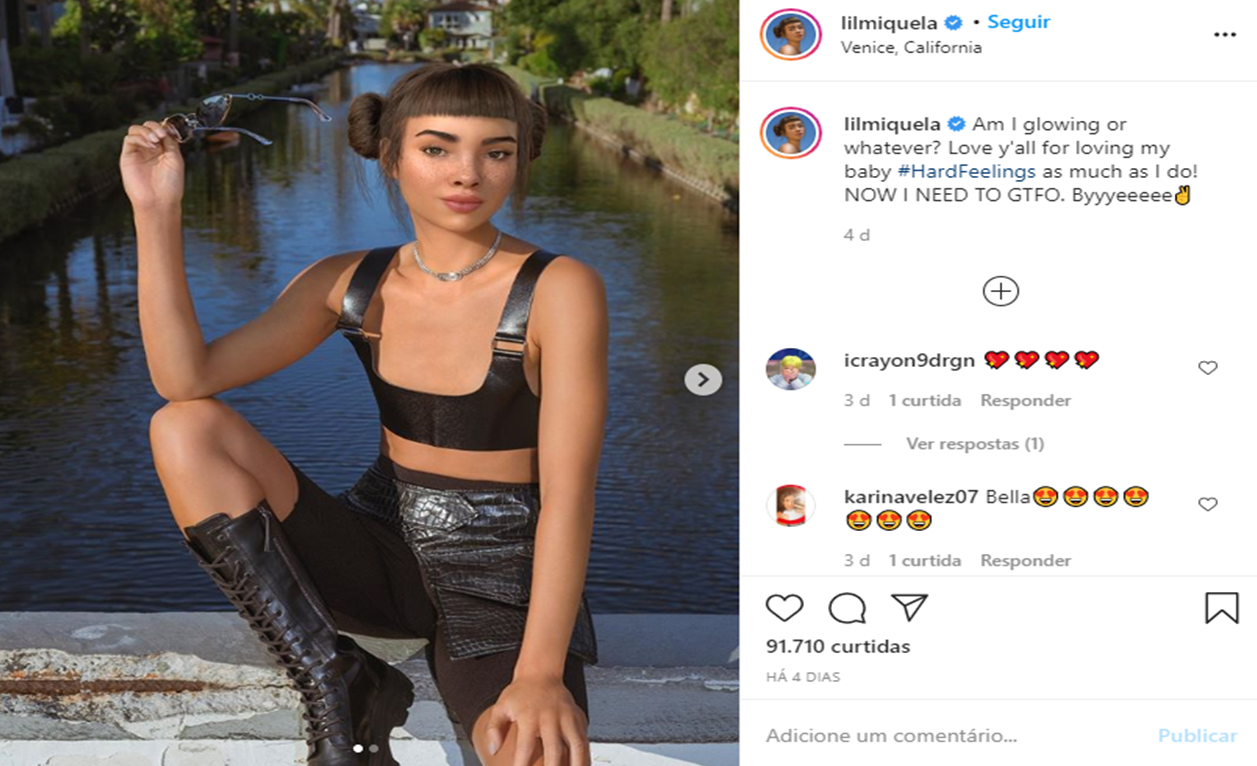
In these four lines of text, the influencer uses multiple elements to reinforce her message:
Slang: “GTFO” and “y’all.”
Emojis: She uses emojis at the end of the text.
Extended words: “Byyeeeee.”
Comments
The comments section is also essential for Miquela’s interaction with the audience. The picture below is a video in which she provides a sneak peek of her latest song, “Hard Feelings”:
Miquela’s post on Instagram. Screenshot courtesy of the author.
Precisely like the captions, the comments also have some lessons:
Reply: Miquela replies to comments of the audience, which increases engagement.
Language: The style of the comment is remarkably similar to the caption. She maintains the same form of communication.
Emojis and abbreviations: Both elements present in the comment that make it informal.
Videos
Instead of long IGTV videos, Miquela focuses on short videos on her feed.
These are mostly related to her music — either short video clips or calls-to-action. They are part of an overall strategy to promote the songs.
By making short videos, she gets the message across more directly.
Short videos are more engaging because they are faster to watch.
It keeps communication informal.
Other Features
Instagram is a platform with multiple features. Besides the ones mentioned previously, here’s how Miquela uses IGTV, location, and stories.
IGTV
IGTV is the least used feature in Miquela’s strategy.
Since March of 2019, she has only posted 15 videos. As mentioned previously, she prefers to focus on short posts on the feed when it comes to videos.
Here are some lessons from this:
Intention: Miquela’s videos are short, and most of them have the intention to promote her music. When planning the content production, it’s best to take into consideration the overall strategy — in her case, to sell the music. Posting on IGTV simply to have content makes no sense.
Focus: Miquela uses most of Instagram features. The fact that she doesn’t use IGTV too much doesn’t matter, because she has plenty of good content for the other features, such as highlights and the feed.
Miquela is the perfect example that each influencer has a different niche — and, thus, different strategies. While other influencers use IGTV in their approach, Miquela chose another plan, and it works well for her.
Location
Miquela always uses exciting locations for the posts on her feed.
She’s not afraid to get creative. Locations became a supporting tool to promote her music, and don’t refer to physical locations.
Some examples are “Somewhere Out There,” “Middle of the Dessert,” and “My Own World.”
Stories
Stories are another Instagram feature that Miquela uses well. For the everyday stories, not the highlights, here are the different uses:
Calls-to-action: swipe-ups and links.
Reposting: Miquela often shares pictures from fans listening to her music.
Mixed content: both videos and pictures.
Overall, it feels like she uses it mainly to promote her music. The focus, however, is on the highlights instead of the everyday stories.